Research Interests:
- Economics of Education, Education Development, Education Finance, Cambodia
Education:
- Doctor of Philosophy, Graduate School of International Cooperation Studies, Kobe University (March 2028) [Expected]
- Master of Economics, Graduate School of International Cooperation Studies, Kobe University (March 2025)
- Master of Public Administration, School of International Relations and Public Administration, Fudan University (June 2024)
- Bachelor of Education, Aichi University of Education (March 2021)
Experiences:
- Sponsored Traineeship at UNESCO Regional Office in Bangkok (May 2025 – December 2025)
- Teaching Assistant, “Education Policy Planning” (Dr. Eduardo Velez Bustillo), Graduate School of International Cooperation Studies, Kobe University (February 2025)
- Teaching Assistant, “Value Co-creation for Sustainable Development” (Prof. Mariana Coolican), Graduate School of International Cooperation Studies, Kobe University (January – February 2025)
- Internship at Japan International Cooperation Agency (JICA), Evaluation Department, Evaluation Planning Division (September 2024 – October 2024)
- Internship at Cambodia Development Resource Institute (CDRI) Center for Educational Research and Innovation (December 2023 – May 2024)
- Guest Speaker, the Graduate School of Arts and Sciences, the University of Tokyo (October 2023)
- Guest Speaker, College of Education, University of Hawaii (July, October 2023)
- Part-time lecturer at high schools (April 2021 – March 2023)
Publications:
- Sakurai, A., Koike, T., Yokogawa, N., Watanabe, M., Okamoto, K., & Meidinger, B. (2025). A Structural Analysis of Disaster Memory Inheritance through the Lens of the Kobe Model: A Case Study of Super Typhoon Haiyan in the Philippines. Bōsai Kyōikugaku Kenkyū [Journal of Disaster Education Studies], 6(1). [In Japanese]
- Koike, T. & Ogawa, K. (2024). “Influence of Teacher Support and Classroom Discipline on Learning Achievement in Cambodian Secondary Schools: Focus on Students’ Socioeconomic Status.” Bulletin of Japanese Comparative Education Society, 69, 112-130. (E).
Academic Associations:
- Japan Comparative Education Society (JCES)
- Japan Society for African Education Association (JSAER)
- Japan Society for International Development (JASID)
- Japan Evaluation Society (JES)
Academic Conference Presentation:
- Koike, T. “A Spatial Analysis of Double-Shift Schooling in Cambodia.” Paper presented at the 14th Biennial Conference of the Comparative Education Society of Asia, Allama Iqbal Open University, November 14th, 2025. (E)
- Koike, T. “Double-Shift Schooling in Cambodian Primary Education: Spatial Determinants and Educational Impacts.” Paper presented at the 2025 Campus Asia Plus Symposium, The National University of Laos, August 21, 2025. (E)
- Koike, T. “Learning Poverty and Double-Shift Schooling in Primary Education in Sub-Saharan Africa.” Poster presented at the 35th Annual Conference of the Japanese Society for International Development, Hosei University, November 11, 2024. (E)
- Koike, T. “Instructional Time and Learning Outcomes in Primary Education in Cambodia.” Paper presented at the 21st International Education Development Forum, Hiroshima University, October 13, 2024. (E)
- Koike, T. “Instructional Time and Learning Achievement in Southeast Asia.” Paper presented at the 2024 JASID-Tokai Conference for Young Researcher, Nagoya University, September 20, 2024. (E)
- Koike, T. “The Influence of Learning Environment on Learning Achievement in Cambodian Secondary Education.” Paper presented at the Japan Comparative Education Society, Nagoya University, June 30, 2024. (E)
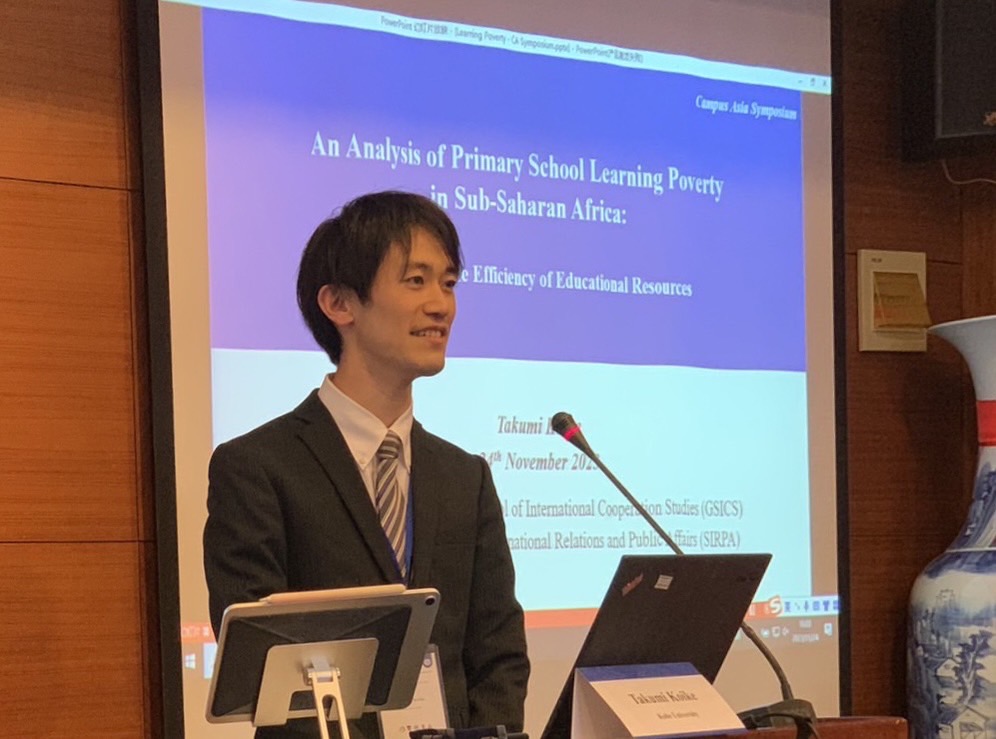
- Koike, T. “An Analysis of Primary School Learning Poverty in Sub-Saharan Africa: Focusing on the Efficiency of Educational Resources” Paper presented at the 2023 Campus Asia Symposium, Fudan University, November 2023. (E)
- Koike, T. “The Association between Classroom Disciplinary Climate, Sense of School Belonging, and Learning Achievement in Cambodian Secondary Education” Paper presented at the 7th International Conference and Ph.D Colloquium for Economics & Business, Faculty of Economics and Business, Universitas Airlangga, October 4, 2023. (E)
Scholarships, Awards:
- Selected as a recipient of the SPRING “Premium Program” (August 2025)
- Selected as a recipient of the SPRING “Prioritized Research Funds” (August 2025)
- Selected for full exemption from repayment of the Japan Student Services Organization (JASSO) Type I Scholarship based on outstanding academic performance (June 2025)
- Selected as the Valedictorian of the Master’s Program at the Graduate School of International Cooperation Studies, Kobe University (March 2025)
- JST SPRING Scholarship (Research grant: JPY 2.2 million/year; Research expenses: JPY 250,000/year) (April 2025 – March 2026)
- Kobe University Scholarship for “Doctoral Program Applicants” (March 2024)
Language/ Skills:
- Japanese, English
- STATA, R, QGIS, Microsoft (Word, Excel, PowerPoint)
Message to Potential Candidates to Ogawa Seminar:
My name is Takumi Koike, and I am a master’s student at the Graduate School of International Cooperation Studies at Kobe University. During my undergraduate years, I visited developing countries, mainly in Southeast Asia, which sparked my interest in the field of education. After graduating from undergraduate school, I worked as a teacher in a Japanese high school for two years, but I decided to enroll in GSICS because I wanted to contribute to education in developing countries.
Now, through the activities in the Ogawa Seminar, I have opportunities to work towards my desired future image and goals. I also feel that I can improve myself through various experiences in the Ogawa Seminar, such as internships at international organizations and government agencies of developing countries, and research presentations at academic conferences. I am grateful to Professor Ogawa for providing me with such an environment, and I am engaged in friendly competition with other members of this seminar every day. Let us improve ourselves together in the Ogawa Seminar.