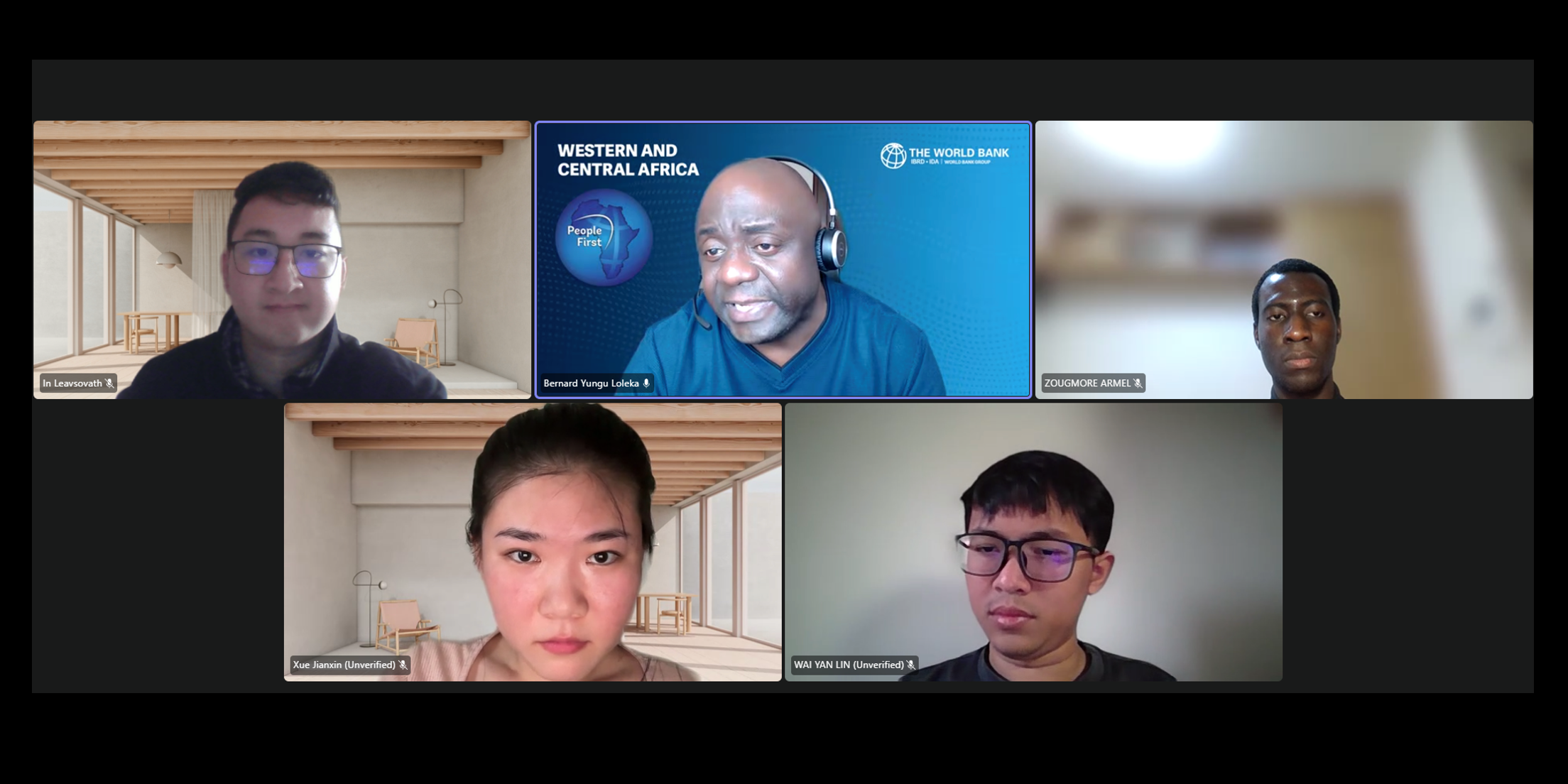
From 15th February to 31st March 2026, five master’s students from the Graduate School of International Cooperation Studies (GSICS), Kobe University, under the supervision of Professor Ogawa Keiichi, undertook a remote internship with the World Bank. The internship was conducted under the guidance of Dr. Bernard Yungu Loleka, Education Economist with the World Bank’s Western and Central Africa Region. The student team consisted of ZOUGMORE Armel, IN Leavsovath, HACHIYA Yuki, and XUE Jinxin (second-year master’s students), along with WAI Yan Lin (a first-year master’s student). This internship provided valuable hands-on experience working on a World Bank project with academic credit at Kobe University.
During the first week of the internship, the students held an introductory meeting with Dr. Loleka to become familiar with key concepts and terminology used in World Bank project financing. He guided the students to review the Terms of Reference (ToR), which outlined the expected deliverables, as well as the Project Appraisal Document (PAD) for the Republic of Congo project, Transforming the Education Sector for Better Outcomes and Results (TRESOR). As the project had only recently begun, this initial phase was important for building a clear understanding of the expected outputs and priorities during the first year of implementation.
During the second and third weeks, the students were assigned the first task, which focused on drafting a technical note on World Bank projects. As they became more familiar with the TRESOR project and its six Disbursement-Linked Indicators (DLIs), Dr. Loleka assigned each student to take over their respective DLIs. This allowed them to conduct stakeholder mapping and carry out gap analysis for their areas. As noted earlier, this task was primarily focused on activities related to the first year of the project, making it highly relevant to the current stage of implementation.
During the fourth and fifth weeks, students were required to work on the second task, which focused on developing key components of the intervention design toolkit, along with a contingency option. This required them to review previous projects and identify how lessons learned could be applied to the current project. As the task was highly technical, students also conducted additional research to identify best practices from previous projects and assess how these could inform the development of the toolkit.
In the final week, the students held a follow-up meeting to review their progress and ensure that all tasks were completed on time. Dr. Loleka expressed his appreciation for the team’s efforts, noting that the students not only met the deadlines but also delivered work that met the expected quality and standards.
In conclusion, we are very grateful to Professor Keiichi Ogawa and Dr. Bernard Yungu Loleka for giving us the opportunity to gain hands-on experience working on a World Bank project. This internship provided us with valuable knowledge and practical lessons that will be highly useful for our future careers, particularly for positions at the World Bank and other international organizations.
Author: In Leavsovath and Armel Zougmore (Master’s students)
Related