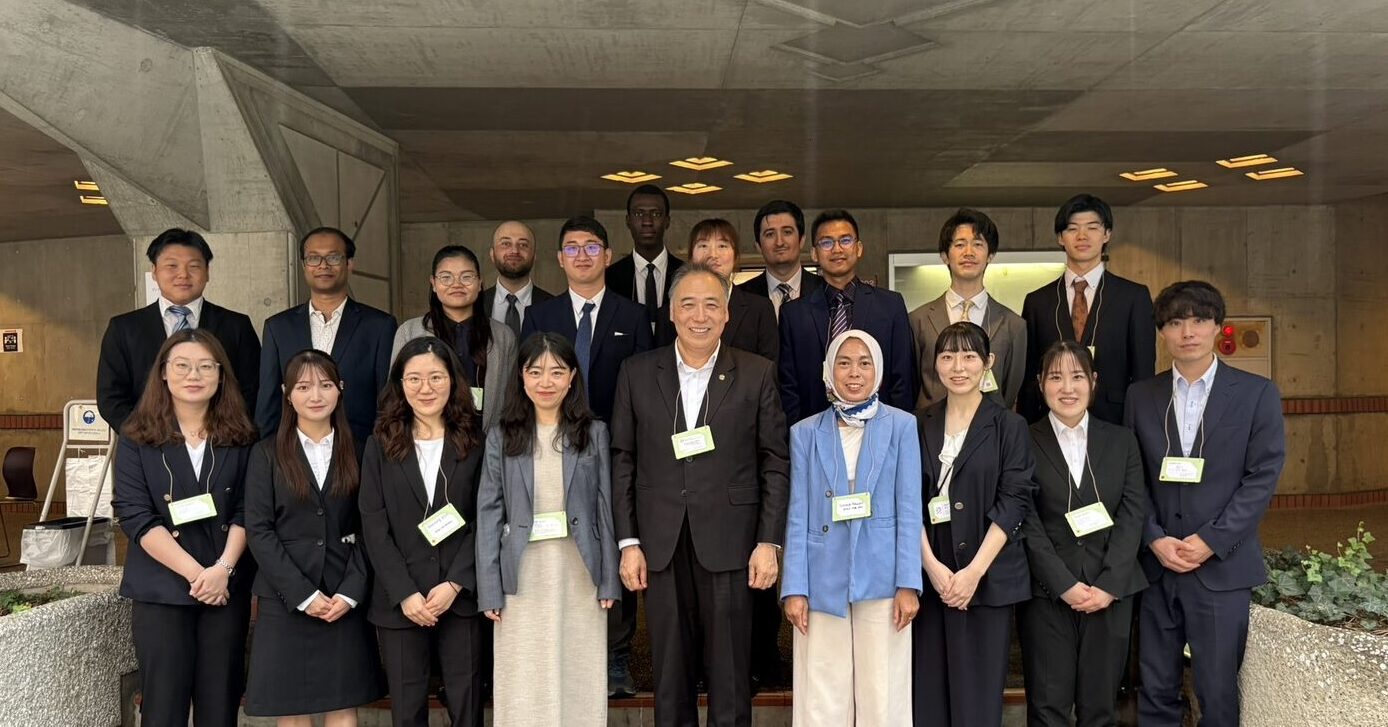
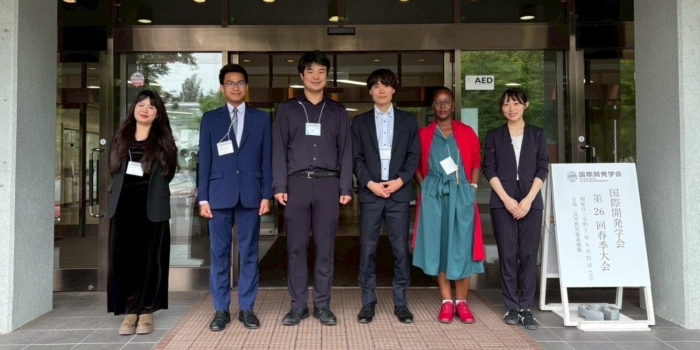
On Saturday, June 27, 2026, the 27th Japan Society for International Development Spring Conference was held at Meiji Gakuin University under the theme “Ancient Futures: Development by the Ordinary People.” The conference featured a total of 85 presentations, including 51 oral presentations, 10 round tables, three planned sessions, and 21 poster presentations, covering a wide range of topics such as politics, educational development, migration and refugees, sustainability, poverty, gender, peacebuilding, disasters, and health and sanitation. From Professor Ogawa Seminar, 13 current students and alumni participated in the conference and presented their research findings in the poster session.
Mr. Yousuf Daas and Ms. Noa Yokogawa were awarded the “Excellent Poster Prize.”
 Mr. Daas’s poster presentation examined how the number of school-aged siblings influences children’s foundational learning skills and mental health in Palestine. Using a mixed-methods approach, the study combined nationally representative survey data with qualitative interviews to investigate how family size shapes children’s literacy, numeracy, and psychological well-being. To strengthen causal inference, the analysis employed an instrumental variable approach, using twin births as an instrument for sibship size. The findings showed that a larger number of school-aged siblings reduces children’s literacy and numeracy outcomes, primarily through lower parental involvement, while the effects on mental health are more nuanced, encompassing both protective and adverse outcomes. The study also explored how parents allocate limited time and resources among their children, highlighting the important roles of socioeconomic conditions, gender, and cultural norms in shaping these allocation decisions.
 Ms. Yokogawa gave a research presentation entitled “The Mechanism of School–Industry Partnerships: A Multiple Case Study of Vocational High Schools in Surabaya, Indonesia.” Based on fieldwork conducted in Surabaya, Indonesia, last summer, this study analyzed how partnerships between vocational high schools and industry are formed and maintained, using signaling theory. The findings showed that many schools commonly use graduate employment outcomes, students’ attitudes, previous partnership experiences, and the visibility of school activities through social media as signals of school quality to firms. At the same time, schools with established trust-based relationships with firms and strong alumni networks are more likely to secure partnership opportunities continuously, while schools with fewer accumulated achievements tend to face more unstable partnership formation. This study explains this process through the framework of signaling theory, focusing on how schools signal their credibility and capacity to firms in order to build and maintain partnerships. Overall, the study suggests that school–industry partnerships not only create internship opportunities, but may also contribute to the cumulative widening of opportunity gaps among vocational high schools through accumulated school reputations and firm evaluations.
Ogawa seminar students presented their research findings on the following topics. All presentations listed below were delivered in English, as indicated by “(E)” (in alphabetical order).
- Aung, H. M. “Examining Changes in Primary Students’ Achievement in Myanmar: Evidence from SEA-PLM 2019 and 2024” Proceedings of the 27th Japan Society for International Development Spring Conference, p. 61, 2026 (E)
- Daas, Y. “Exploring the Effect of Sibship Size on Primary and Lower Secondary School Children’s Foundational Learning Skills & Mental Health in Palestine” Proceedings of the 27th Japan Society for International Development Spring Conference, p. 61, 2026 (E)
- Guo, R. “Determinants of Teachers’ ICT Readiness and Classroom Integration in Cambodian Secondary Education” Proceedings of the 27th Japan Society for International Development Spring Conference, p. 62, 2026 (E)
- Hoeun, S. “Investigating the Influence of School-Based Management (SBM) on Secondary School Students’ Achievement in Cambodia” Proceedings of the 27th Japan Society for International Development Spring Conference, p. 61, 2026 (E)
- In, L. “Analyzing the Effect of Digital Learning Resources and School Support on Student Learning Achievement in Cambodian Secondary Schools” Proceedings of the 27th Japan Society for International Development Spring Conference, p. 61, 2026 (E)
- Ishii, Y. “Women’s Negotiation and Kinship Dynamics in the Allocation of Resources for Children’s Primary Education in Malawi: The Cases of Lilongwe, Blantyre, and Zomba” Proceedings of the 27th Japan Society for International Development Spring Conference, p. 61, 2026 (E)
- Islam, S. R. B. “An Analysis of Factors Influencing Foundational Learning Skills among Primary School Students in Bangladesh” Proceedings of the 27th Japan Society for International Development Spring Conference, p. 62, 2026 (E)
- Khidirov, I. “Influence of out of school ICT Use in Secondary School Achievements in Japan” Proceedings of the 27th Japan Society for International Development Spring Conference, p. 61, 2026 (E)
- Kim, N. “The Determinants of the Female Labour Force Participation in Lao PDR” Proceedings of the 27th Japan Society for International Development Spring Conference, p. 62, 2026 (E)
- Koike, T. “Determinants of Double-Shift Schooling in Cambodian Primary Education: Exploring Geographical Mechanisms” Proceedings of the 27th Japan Society for International Development Spring Conference, p. 62, 2026 (E)
- Purwanti, Y. “Urban Wage Premium and Human Capital Spillovers: Empirical Evidence from Jakarta” Proceedings of the 27th Japan Society for International Development Spring Conference, p. 62, 2026 (E)
- Yokogawa, N. “The Mechanism of School–Industry Partnerships: A Multiple Case Study of Vocational High Schools in Surabaya, Indonesia” Proceedings of the 27th Japan Society for International Development Spring Conference, p. 61, 2026 (E)
- Zougmore, A. “Analysis of the Relationship between Teachers’ Code-Switching and Students’ Academic Achievements in Burkina Faso’s Primary Schools” Proceedings of the 27th Japan Society for International Development Spring Conference, p. 61, 2026 (E)
The 37th JASID Annual Conference is scheduled to be held on November 28–29, 2026, at The University of Tokyo.
Authored by Noa Yokogawa (Doctoral student)
Related