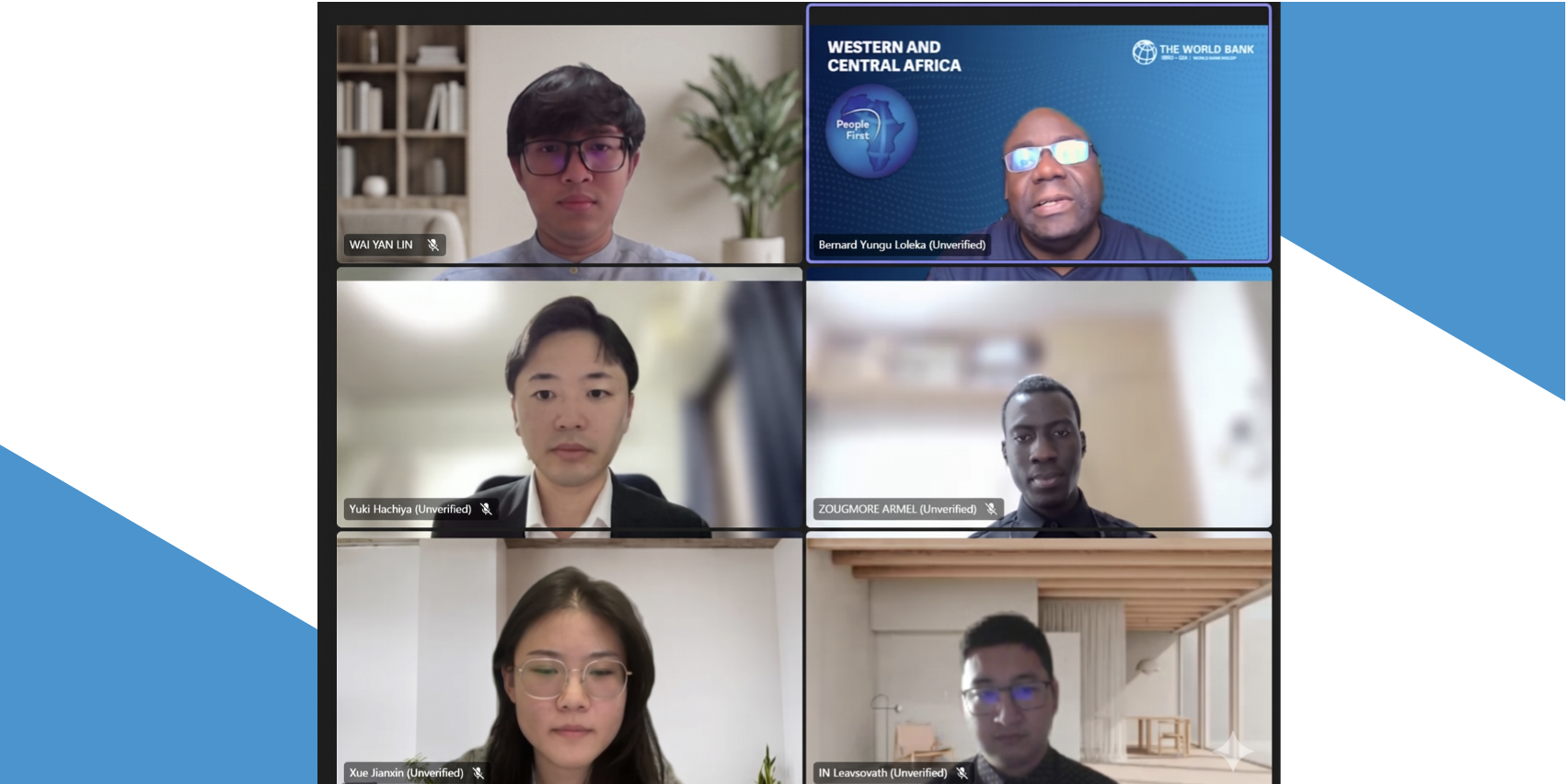
From February 16 to March 31, 2026, I had the incredible opportunity to complete an online internship with the World Bank (the Republic of Congo) under the supervision of Dr. Bernard Yungu Loleka. This experience was centered on the Transforming the Education Sector for Better Outcomes and Results (TRESOR) – Republic of Congo (P179410) project, which is a Program-for-result (PforR) mechanism designed to improve foundational learning and education sector management.
During the internship, my responsibilities were divided into two primary technical tasks that required both analytical depth and creative design. My first task involved developing a detailed Technical Note for Education Sector Data Management, specifically focusing on Year 1 of Disbursement-Linked Indicator 6 (DLI-6). This work required a comprehensive analysis of the TRESOR Project Appraisal Document to map the institutional framework, define expected outputs tied to financing, and establish verification requirements. This note served as a critical resource for stakeholder meetings, ensuring that the financing mechanism remained transparent and results oriented.
For my second task, I designed a comprehensive intervention design brief for foundational mathematics learning interventions, which is to be piloted in the Republic of Congo (ROC). This required me to do comprehensive and intensive literature reviews on how the World Bank and many other international organizations approaches on implementation and designing such kinds of interventions across the world, especially in the Africa region.
This experience significantly evolved my professional competencies, shifting my perspective of international development from the theoretical to the highly operational. I gained practical expertise in the mechanics of PforR financing, and I also learned the vital importance of contextualization; I realized that when working within local capacity limitations, the most effective and innovative solutions are often the simplest, most robust analog models. Furthermore, the internship reinforced the necessity of evidence-based design, as anchoring new interventions in the successes of previous regional projects is essential for gaining the trust and cooperation of national ministries.
This internship was a life-changing chapter in my career, providing an unparalleled view of the rigorous, evidence driven environment of the World Bank. I look forward to translating these skills into my future academic and professional journeys.
I am deeply grateful towards Professor Keiichi Ogawa for his kind support and for giving me the opportunity to do this internship, and to Dr. Bernard for his invaluable mentorship, rigorous feedback, and patience throughout the internship journey.
Authored by Wai Yan Lin (Master’s Student)
Related