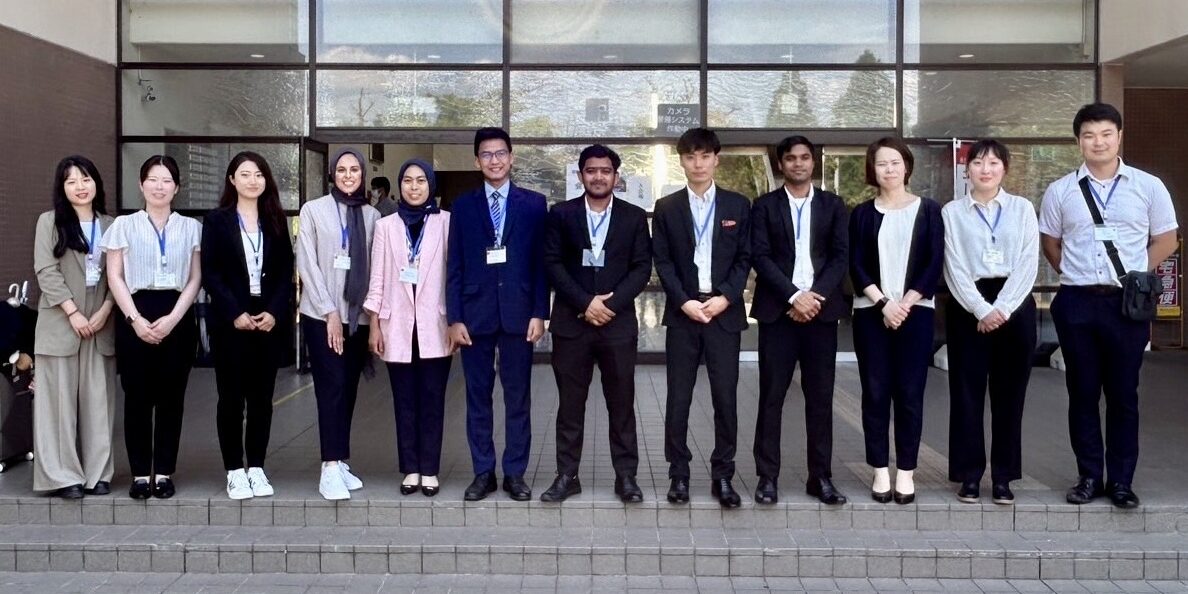
On the 15th and 16th of June 2024, the 25th Japan Society for International Development Spring Conference was held at Utsunomiya University. Under the theme of “Realizing International Cooperation and Interactive Co-creation in Local Context Global & Glocal Human Resource Development.”, 44 oral presentations, 6 round tables, 4 planned sessions, and 25 poster presentations were held at the conference, covering politics, educational development, migration and refugees, sustainability, global development, poverty, gender, peacebuilding, disasters, and sanitary health. From Professor Ogawa’s seminar, 4 doctoral students and 10 master’s students, a total of 14 students presented their research findings at the poster session.
Ms. Mami Fujiwara, a doctoral student, was awarded the “Outstanding Poster Presentation Award.” In addition, Mr. Yudai Ishii, a doctoral student, and Mr. Sheikh Rashid Bin Islam, a master’s student, were awarded the “Excellent Poster Presentation Encouragement Award.”
 Ms. Mami Fujiwara’s theme is “Higher Education Choice Process and Family Involvement in Cambodia”, using qualitative methods to analyze how other family members are involved in students’ higher education choices, as a case study of Cambodia. The results showed that the involvement of other family members is important, especially when the parents have low education. Moreover, this research clarified that the pattern of involvement of family members other than parents is significantly related to family structure, household income, and family occupation.
Mr. Yudai Ishii’s theme is “An Analysis of Intrahousehold Decision-Making on Children’s Schooling in Malawi Primary Education: Focused on Matrilocal Settlements,” using both qualitative and quantitative methods to analyze women’s intrahousehold decision-making and children’s primary education schooling in the matrilocal settlement, as a case study of Malawi. The results showed that women’s intrahousehold decision-making in matrilineal settlement is positively associated with their children’s primary school attendance. Moreover, this research clarified that in Malawi’s matrilineal areas, the wife’s negotiation process is involved in decision-making about children’s primary education, rather than only the husband making intrahousehold decisions.
Mr. Sheikh Rashid Bin Islam’s theme is “An Analysis of Household Factors and its Implications on the Foundational Learning Skills of Primary School Students of Bangladesh,” using quantitative methods to analyze the relationship between children’s foundational learning skills and household factors in primary education, as a case study of Bangladesh. The results showed that household factors such as the age of the child, the mother’s educational background and the household’s socio-economic status are positively associated with children’s foundational learning skills. The results of this study also highlight that children’s involvement in household chores and discipline is positively correlated with foundational learning skills.
Ogawa seminar students presented their research findings on the following topics. The poster, denoted by (E), is in English. (Alphabetical Order)
- Afridi, M. K. “An Analysis of the Influence of Child Labour on School Attendance and Educational Attainment of Primary and Secondary School Children in Bangladesh” Proceedings of the 25th Japan Society for International Development Spring Conference, p34, 2024 (E)
- Aung, H. M. “Analysis of the Influence of Teacher Absenteeism on Students’ Academic Achievements in Six Southeast Asian Countries” Proceedings of the 25th Japan Society for International Development Spring Conference, p. 33, 2024 (E)
- Bekele, M. M. “Two-Stage Analysis of the Efficiency of Public Primary Schools in Ethiopia (Using Data Envelopment Analysis and Tobit Regression)” Proceedings of the 25th Japan Society for International Development Spring Conference, p. 33, 2024 (E)
- Ehab, T. “An Analysis of the correlation between Local Language Literacy and Lower Grades Students’ Academic Achievement” Proceedings of the 25th Japan Society for International Development Spring Conference, p. 33, 2024 (E)
- Fujiwara, M. “Higher Education Choice Process and Family Involvement in Cambodia” Proceedings of the 25th Japan Society for International Development Spring Conference, p. 34, 2024 (E)
- Guo, R. “Influences of Private Tutoring and Teacher Quality on Academic Achievement in Secondary Education in Cambodia” Proceedings of the 25th Japan Society for International Development Spring Conference, p. 34, 2024 (E)
- Hassan, R. “Moderating Role of Parental Socio-economic Status on the Relationship between Parental Involvement and Children’s Foundational Literacy and Numeracy (FLN) Skills in Bangladesh” Proceedings of the 25th Japan Society for International Development Spring Conference, p. 34, 2024 (E)
- Ishii, Y. “An Analysis of Intrahousehold Decision-Making on Children’s Schooling in Malawi Primary Education: Focused on Matrilocal Settlements” Proceedings of the 25th Japan Society for International Development Spring Conference, p. 33, 2024 (E)
- Islam, S. R. B. “An Analysis of Household Factors and its Implications on the Foundational Learning Skills of Primary School Students of Bangladesh” Proceedings of the 25th Japan Society for International Development Spring Conference, p. 34, 2024 (E)
- Lyu, S. “An Analysis of ICT Usage in Teaching and Learning on Secondary School Students’ Academic Achievement in Cambodia” Proceedings of the 25th Japan Society for International Development Spring Conference, p. 34, 2024 (E)
- Mizukure, M. “An Analysis of the Relationship between Menstrual Hygiene Management and Girl’s Academic Achievement in Primary Education in Uganda – Case Studies in the Wakiso, Mukono and Jinja Districts” Proceedings of the 25th Japan Society for International Development Spring Conference, p. 33, 2024 (E)
- Purwanti, Y. “Education Level, Income and Happiness Index in Urban Area: Evidence from Jakarta, Indonesia” Proceedings of the 25th Japan Society for International Development Spring Conference, p. 34, 2024 (E)
- Uno, K. “Heterogeneous Effect of Pre-primary School Attendance on Child Development in Bangladesh” Proceedings of the 25th Japan Society for International Development Spring Conference, p. 34, 2024 (E)
- Yao, J. “Analyzing the Influence of Home Language on Primary Students’ Academic Achievements in Lao PDR” Proceedings of the 25th Japan Society for International Development Spring Conference, p. 34, 2024 (E)


Authored by Mayuko Mizukure (Master’s Student)
Related