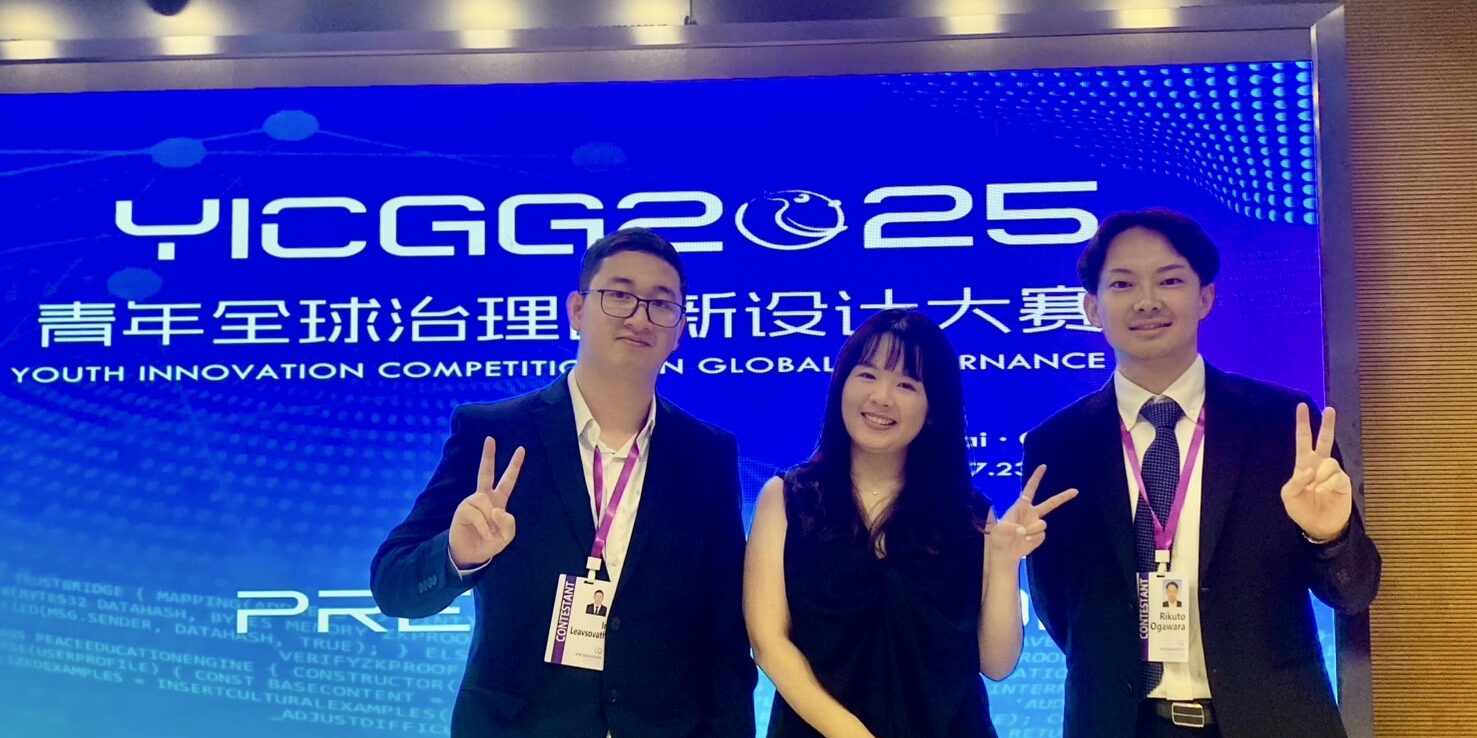
From July 22 to 29, 2025, the 16th “Rong Chang Cup Youth Innovation Competition on Global Governance (YICGG) 2025” was held in Shanghai and Beijing, China. It was established in 2007 by Fudan University with support from the United Nations Development Programme, which has become a prominent international competition. To date, more than 3,200 students from 110 countries and regions have participated, submitting over 1,200 proposals for global governance solutions. Three students from Professor Ogawa’s seminar at the Graduate School of International Cooperation Studies (GSICS) – Jiling Yao (1st-year doctoral student), Rikuto Ohgawara (2nd-year master’s student), and In Leavsovath (1st-year master’s student) – participated in this international event. The competition was held under the theme “AI Governance for Tomorrow: Peace, Trust and Inclusion”, bringing together around 100 young scholars selected from 38 countries to present innovative ideas on how AI can contribute to peacebuilding and inclusive global governance.
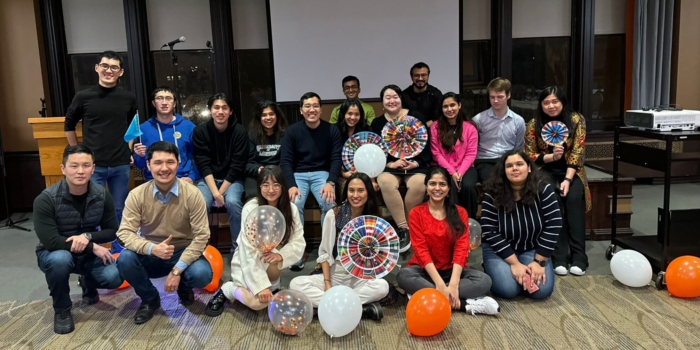
 During the program, we took part in a variety of activities, including visits to AI research institutes and corporate labs in Shanghai and Beijing, panel discussions with experts, academic exchanges with international scholars, Ignite Talks, and the Cultural Night. In the final round, World Team 8, which included Mr. Rikuto Ohgawara, won the competition’s highest honor – the Most Valuable Project Award – for their proposal “GAIA Voice: The AI Peacemaker for Nature.” We also attended the World Youth Conference for Peace, held at Peking University, which gathered young people and professionals from around the world to discuss peacebuilding initiatives. Working intensively with peers from diverse cultural and academic backgrounds to produce high-quality proposals in a short period of time allowed the students to deepen their understanding of global governance while significantly enhancing their teamwork and cross-cultural communication skills.
Last but not least, we would like to express our heartfelt gratitude to Fudan University and the Shanghai Rong Chang Public Welfare Foundation, as well as to all student staff members for their dedication in organizing this event. We are especially thankful to Professor Keiichi Ogawa for his invaluable guidance and support throughout the application process and beyond.
Authored by Jiling Yao (Doctoral Student)
Related