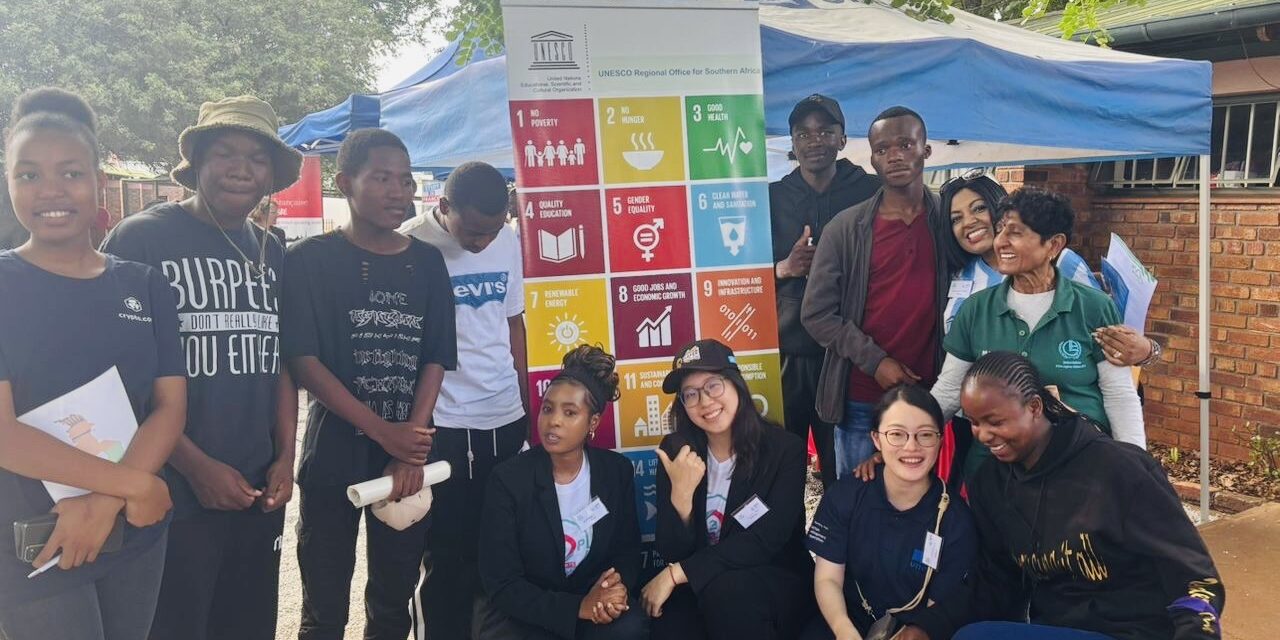
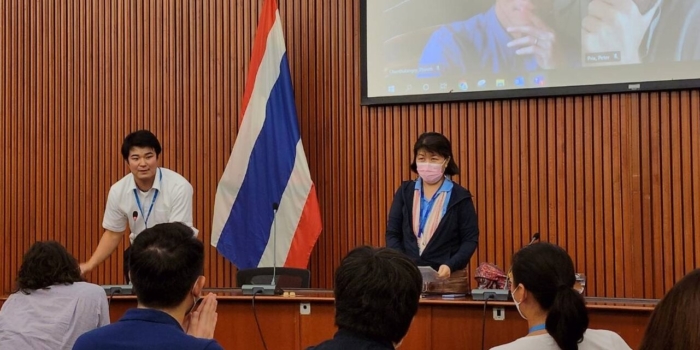
From October 27, 2025, to April 27, 2026, I conducted a traineeship at the UNESCO Regional Office for Southern Africa (UNESCO ROSA) in Harare, the capital of Zimbabwe. The UNESCO Traineeship Program is jointly implemented by Japan’s Ministry of Education, Culture, Sports, Science and Technology (MEXT), specifically the Japanese National Commission for UNESCO, and UNESCO. The program aims to promote understanding of UNESCO’s activities, develop global human resources, including future international organization professionals, and contribute to regional revitalization through UNESCO-related activities. Students enrolled at universities designated as UNITWIN/UNESCO Chairs may be recommended by their universities and undertake training for a period of six months to one year at UNESCO Headquarters or UNESCO regional offices.
UNESCO ROSA, where I was placed, covers nine countries: Botswana, Eswatini, Lesotho, Malawi, Mozambique, Namibia, South Africa, Zambia, and Zimbabwe. The office implements projects in these countries in areas such as education, culture, natural sciences, and communication and information. I was primarily assigned to the disaster risk reduction project team within the Natural Sciences Sector, while I was also given the opportunity, thanks to the support of the office, to participate in projects in the Education Sector.
During the traineeship, I was mainly engaged in (1) activities in the Natural Sciences sector, (2) activities in the Education sector, and (3) office operations. Through these experiences, I deepened my understanding of how UNESCO conducts its work and of the regional context in Southern Africa.
(1) Support for Activities in the Natural Sciences Sector
Zimbabwe is highly vulnerable to the impacts of climate change and, in recent years, has experienced frequent damage from cyclones and droughts. UNESCO ROSA is implementing a project on flood early warning systems in Zimbabwe and Mozambique, which aims to reduce the vulnerability of local communities through effective flood risk assessment and early warning systems. In relation to this project, I collected and organized data on the impacts of cyclones and droughts in Zimbabwe over the past 30 years and compiled the information in a way that clearly showed trends in damage and economic losses.
In addition, I reviewed and consolidated ten reports on past activities conducted by the Natural Sciences Sector of UNESCO ROSA in Zimbabwe, transforming text-heavy content into more visually accessible formats. Through this work, I gained a better understanding of past initiatives and learned how to structure and present information more effectively for communication with external stakeholders.
Furthermore, I provided operational support for AfriMAB, which was held in Livingstone, Zambia, in March 2026. AfriMAB is an international meeting related to UNESCO’s Man and the Biosphere (MAB) Program, bringing together around 200 experts and policymakers from across Africa. In this role, I was involved from the initial stage of identifying potential invitees and presenters, including compiling lists and coordinating communication with stakeholders. Since participation confirmations were often finalized close to the event, coordination posed certain challenges. However, this experience allowed me to gain practical insights into communication methods and coordination processes for international conferences involving diverse stakeholders.
I also participated in several meetings related to natural sciences and disaster risk reduction, including meetings focused on resilience-building, biodiversity, and water resource management. These meetings brought together representatives and officials from various ministries and international organizations for information-sharing and discussion. Through my participation, I deepened my understanding of the roles and mandates of different institutions, as well as their approaches to collaboration.
(2) Support for Activities in the Education Sector
Under the Education for Health and Wellbeing initiative, UNESCO ROSA has been implementing the “Our Rights, Our Lives, Our Future (O3)” programme since 2018, with the aim of ensuring that all young people in Sub-Saharan Africa achieve positive outcomes in health, education, and gender equality. Following the completion of Phase I in 2023, Phase II is currently underway.
As part of the program’s monitoring and evaluation, I collected both historical and the most recent data on nine indicators related to health, education, and gender equality among young people aged 15 to 24 across 27 African countries, using datasets such as DHS and MICS. I organized the data into a standardized format to enable cross-country comparisons and drafted country-specific summaries for inclusion in program reports. This analysis helped identify countries where project outcomes were not yet sufficiently evident, and the findings were subsequently used as reference material to inform future program implementation strategies.
In addition, I supported the implementation of a STEM education promotion project for female students by assisting with the organization of an event held in South Africa. My responsibilities included drafting invitation letters addressed to ministers and guest speakers, as well as reviewing related materials. I also participated in meetings with government officials and local companies, which provided me with practical insights into how UNESCO ROSA implements education projects and collaborates with governments and private sector partners.
(3) Support for Office Operations
In February, I had the opportunity to accompany the Assistant Director-General of UNESCO’s Communication and Information Sector during an official visit to Zimbabwe. As part of this visit, I attended courtesy meetings with the Ambassador of Japan to Zimbabwe and Zimbabwe’s Minister of ICT. This experience provided me with insight not only into the relationship between international organizations and the Government of Japan, but also into how international organizations engage with and build relationships with host country ministries.
In addition, I supported Staff Association activities, where I was involved in organizing events aimed at fostering interaction among staff members. During the preparation process, I worked with colleagues across different sectors, which allowed me to build new connections with individuals I had not previously interacted with. As a result, day-to-day communication became smoother, reinforcing my understanding of the importance of regular communication and relationship-building in facilitating effective workplace operations.
Through this internship, I not only gained practical experience in an international organization but also learned a great deal from interacting with professionals from diverse backgrounds. On weekends, I had opportunities to speak with Japanese professionals working at other international organizations, staff members from the Embassy of Japan in Zimbabwe, and members of the Japan International Cooperation Agency (JICA). These interactions allowed me to develop a more concrete understanding of the roles, responsibilities, and career paths associated with different institutions, making this an important experience in shaping my future career plans.
I also had the opportunity to attend a presentation session by members of the Japan Overseas Cooperation Volunteers (JOCV), where I learned about their grassroots-level activities. While my work at UNESCO primarily involved engagement with policy-level stakeholders, such as government officials, and was conducted within a regional office covering multiple countries, I sometimes felt that I was not fully able to grasp the realities on the ground in Zimbabwe. However, through my interactions with JOCV members, I was able to gain more concrete insights into local community conditions and the challenges faced on the ground, which broadened my overall perspective on Zimbabwe.
Lastly, I would like to express my sincere gratitude to Dr. Martiale Zebaze Kana, Officer-in-Charge of the UNESCO Regional Office for Southern Africa, as well as to all members of UNESCO ROSA, for providing me with this valuable opportunity. I am also deeply grateful to Professor Keiichi Ogawa for his encouragement and support throughout the application process and during the internship, and to all those who supported me throughout this experience.

Authored by Miyoko Watanabe (Master’s student)
Related