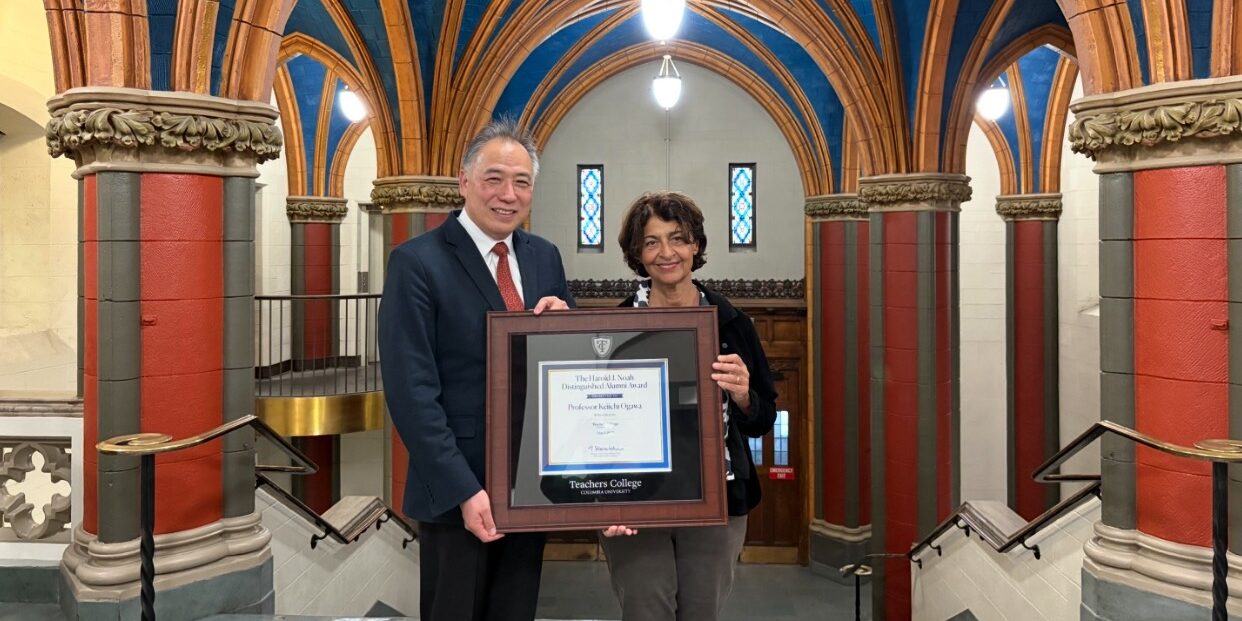
Professor Keiichi Ogawa received the Harold J. Noah Distinguished Alumni Award in Comparative and International Education from Teachers College, Columbia University.
Harold J. Noah (1925 – 2019) was a professor and dean at Teachers College from 1964 to 1987. As an alumnus of the College’s Comparative Education program, he was instrumental in developing the fields of international and comparative education in the United States and abroad. The Program in International and Comparative Education established the award in his name to acknowledge and celebrate the achievements of distinguished alumni in the following areas:
- Advancement of scholarship in the field of international and comparative education
- Advancement of applied work in international and comparative education
- Advancement of international and comparative education as a field of undergraduate or graduate study at universities
- Strengthening of professional associations of international and comparative education in the United States or elsewhere
- Establishment of solid networks with institutions, agencies, or universities beyond their own workplace.
According to Dr. Gita Steiner-Khamsi, Chair of the Harold J. Noah Award Committee (AY 2025/26) and William Heard Kilpatrick Professor of Comparative Education, Professor Ogawa was selected for the Harold J. Noah Distinguished Alumni Award for his long-standing and illustrious service in international and comparative education. Upon completing his doctoral degree in Comparative Education with a concentration in Economics of Education in 1999, he first worked for eight years as an education economist at the World Bank. His academic career began when he assumed a professorship at Kobe University in 2007. The list of accomplishments during his tenure at the Graduate School of International Cooperation Studies at Kobe University is too long to enumerate here.
It is noteworthy that he bridges different communities—academia, international cooperation agencies, governments, think tanks, and professional associations of comparative and international education—and makes his vast network available to his students and peers.
For example, Professor Ogawa has published eight books and more than 100 journal articles and book chapters, and he holds several honorary doctoral degrees from universities around the world. Several universities in the United States have invited him to serve as a visiting professor, including the University of Hawai’i, George Washington University, and Teachers College, Columbia University. He has worked in more than 30 countries, advising governments and international donors on international education development. He has received awards for distinguished service from the governments of Lao PDR, Uganda, Yemen, Malaysia, Saudi Arabia, and Kyrgyzstan. He has served for many years on the Governing Board of the UNESCO International Institute for Educational Planning (IIEP) in Paris. He has also greatly advanced the professionalization of comparative and international education as President of the Japan Society for Africa Educational Research, Secretary-General of the Japan Society for International Development, and Board Member of the Japan Comparative Education Society.
Last but not least, Professor Ogawa is a supportive and caring advisor to a vast number of doctoral and master’s degree students who, due to his commitment to them, have secured influential positions in the field of international and comparative education, whether in academia, in governmental and nongovernmental organizations, or international cooperation agencies in Japan and internationally (as noted by Professor Gita Steiner-Khamsi, Chair of the Award Committee).
The awarding institution, Teachers College, Columbia University, is the oldest graduate school of education in the United States. Founded in 1887, it is internationally renowned and was the first institution in the world to offer a graduate course in comparative education in 1898. In the U.S. News Education Rankings, it was ranked No. 1 among graduate schools of education in 2023 and 2024, and No. 2 in 2025.
For more information, please see the article by Teachers College, Columbia University.
Related