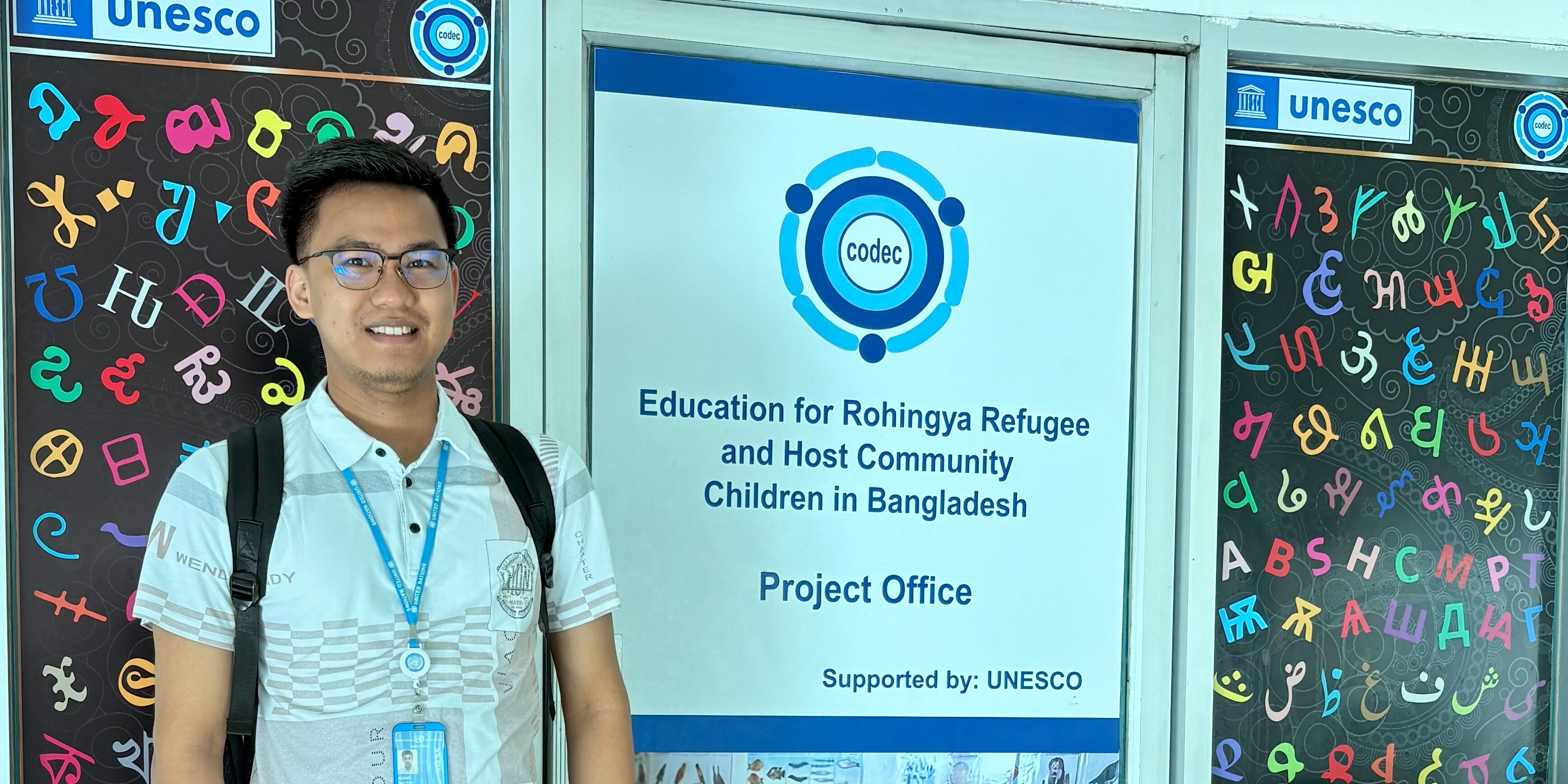
From 3 August to 31 December 2025, I worked as an Individual Consultant for Education with the UNESCO Dhaka Office, Bangladesh, under the Education for Rohingya and Host Community Children programme. The programme aims to equip teachers with the linguistic skills necessary to deliver quality education to Rohingya children and the refugee community in Cox’s Bazar using the Myanmar national language.
Under the direct supervision of the Project Officer at the Cox’s Bazar Project Office and the guidance of the Head of Education at the UNESCO Dhaka Office, I supported the Cox’s Bazar education response. My work focused on strengthening Burmese language proficiency among teachers delivering the Myanmar Curriculum in learning centres for Rohingya and the host community learners. To achieve this, the consultancy combined teacher professional development, curriculum implementation support, and applied research within a humanitarian education context.
A core component of my role was the design and delivery of structured Burmese Language Training modules for teacher trainers across multiple training cycles. The training integrated language proficiency development with pedagogical application, ensuring that teacher trainers could effectively deliver subject content using curriculum-appropriate terminology and instructional discourse. In parallel, I mentored teacher trainers and trainees, strengthening their facilitation skills, session planning capacity, and feedback mechanisms to promote sustainability and peer-led professional learning within the education response.
Beyond direct training delivery, I supported the operationalization and monitoring of the Myanmar Curriculum across selected learning centres. This included developing curriculum-aligned lesson materials, language scaffolding guides, and formative assessment tools tailored to the classroom realities of Cox’s Bazar. I worked closely with the implementing partner, CODEC (Community Development Centre), and relevant authorities to ensure that training content was technically coherent, contextually appropriate, and aligned with sector standards and coordination frameworks.
An important analytical component of the consultancy was the design and implementation of an impact evaluation of the Burmese Language Training programme. I developed data collection tools, conducted structured field observations, and analysed teacher language use and instructional practices before and after the intervention. The evaluation generated evidence of improvements in instructional clarity, curriculum terminology usage, and teacher confidence, providing actionable recommendations for strengthening future BLT cycles and informing broader teacher support strategies within the response.
Throughout the consultancy, I actively engaged in sector coordination and knowledge-sharing platforms, including Inter-agency Network for Education in Emergencies (INEE) coordination discussions. These forums enabled cross-agency dialogue on curriculum implementation, teacher professional development, and quality assurance in emergency education settings. Through this engagement, I contributed to strengthening technical exchange and aligning project implementation with broader humanitarian education priorities in Cox’s Bazar.
I would like to extend my sincere thanks to Dhana Ranjan Tripura, Programme Officer at UNESCO Cox’s Bazar Project Office, and colleagues from the CODEC office for their collaboration and support. Finally, I would like to express my sincere gratitude to Professor Keiichi Ogawa, my academic supervisor, whose guidance and mentorship were instrumental throughout this consultancy. His continued support has significantly enriched my academic development and professional engagement in international education cooperation.


Authored by Htet Myet Aung (Doctoral Student)
Related