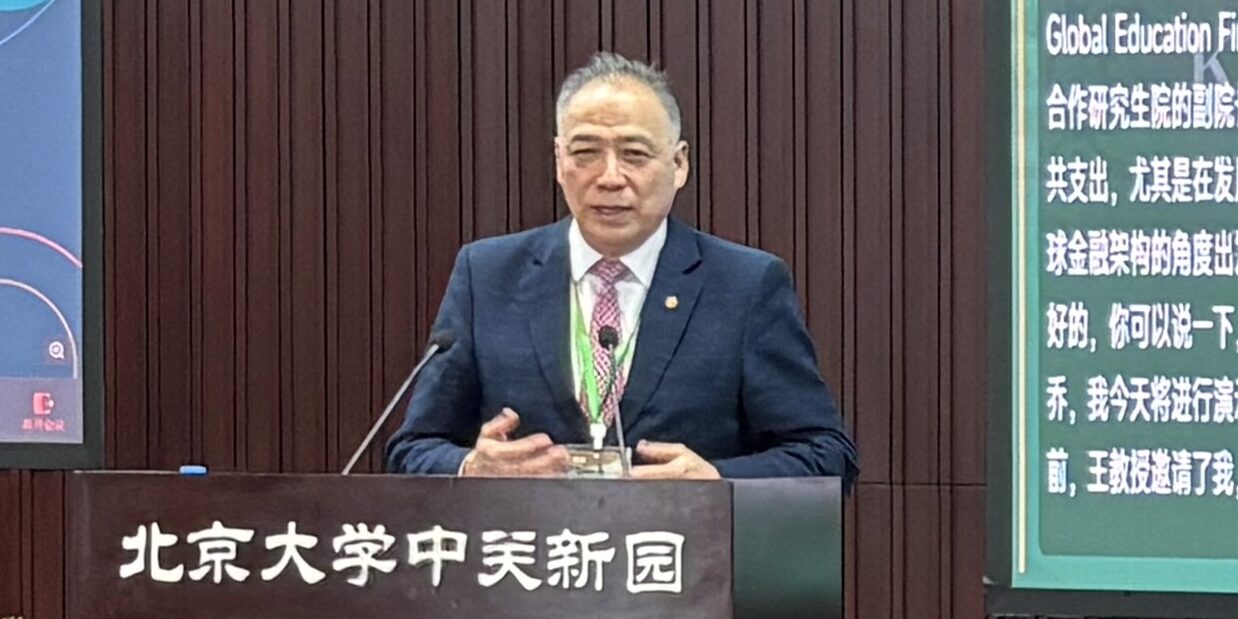
On November 9, 2026, Professor Keiichi Ogawa delivered an invited keynote speech at the First International Conference on Education Finance and Science & Technology Finance at Peking University in Beijing, China. Held from November 9 to 10, the conference was jointly organized by Peking University’s China Institute for Educational Finance Research (CIEFR) and the Education Finance Committee of the Chinese Society of Educational Development Strategy, with Peking University’s Future Education Center serving as co-organizer.
Under the theme “Education and Financing in the Age of Artificial Intelligence,” the event explored how education finance can drive technological innovation while advancing equity and quality. Featuring scholars from Kobe University, Peking University, the University of Nottingham, and France’s Académie des sciences d’outre-mer, the keynote program addressed technology transfer in emerging economies, China’s education finance system, global education partnerships, international education finance, and open-source knowledge production. Five thematic forums grounded these broader themes in local and institutional practice, examining household education spending, university and industry collaboration, financial resilience in private higher education, grassroots innovation in basic education, and university financial governance in the AI era. The conference also marked the launch of the China Household Education Finance Survey Report (2023) and the release of its 2025 dataset.
Professor Ogawa, who serves as Vice Dean of Kobe University’s Graduate School of International Cooperation Studies (GSICS), Director of the Global Research Center for Education Policy and Planning (GEPP), and Chairholder of the UNESCO Chair on Education for Gender, Disaster Resilience, and Well-being, presented a keynote titled “Education Finance from the Perspective of the Global Financing Architecture.” Drawing on data from the OECD, World Bank, UNESCO, and UNICEF, he illustrated how aid reductions, debt burdens, and shifting fiscal priorities are squeezing education budgets. He noted that development aid fell by 23.1% in 2025 and that a year of direct aid to education equals approximately 1.5 days of global military spending. He argued that international institutions are losing the resources needed to fulfill their commitments, putting basic education, low-income countries, and crisis-affected children at particular risk. He called for protecting education funding for vulnerable learners, strengthening agencies’ core budgets, expanding debt relief and debt-for-education swaps, and coordinating humanitarian and development financing. He concluded that approximately 12 days of global military spending, or US$97 billion, would cover the annual SDG 4 financing gap for the 79 poorest countries.
Bringing together approximately 150 researchers, policymakers, and practitioners, the conference provided a vital platform for cross-border dialogue on the future of educational investment. Professor Ogawa’s keynote complemented discussions of technological change by emphasizing the financial foundations needed to sustain essential education services. His participation linked global financing challenges with China’s policy experiences and provided opportunities for further academic exchange among Kobe University, Peking University, and the international research community.
Authored by Dr. Kexin Wang
Related