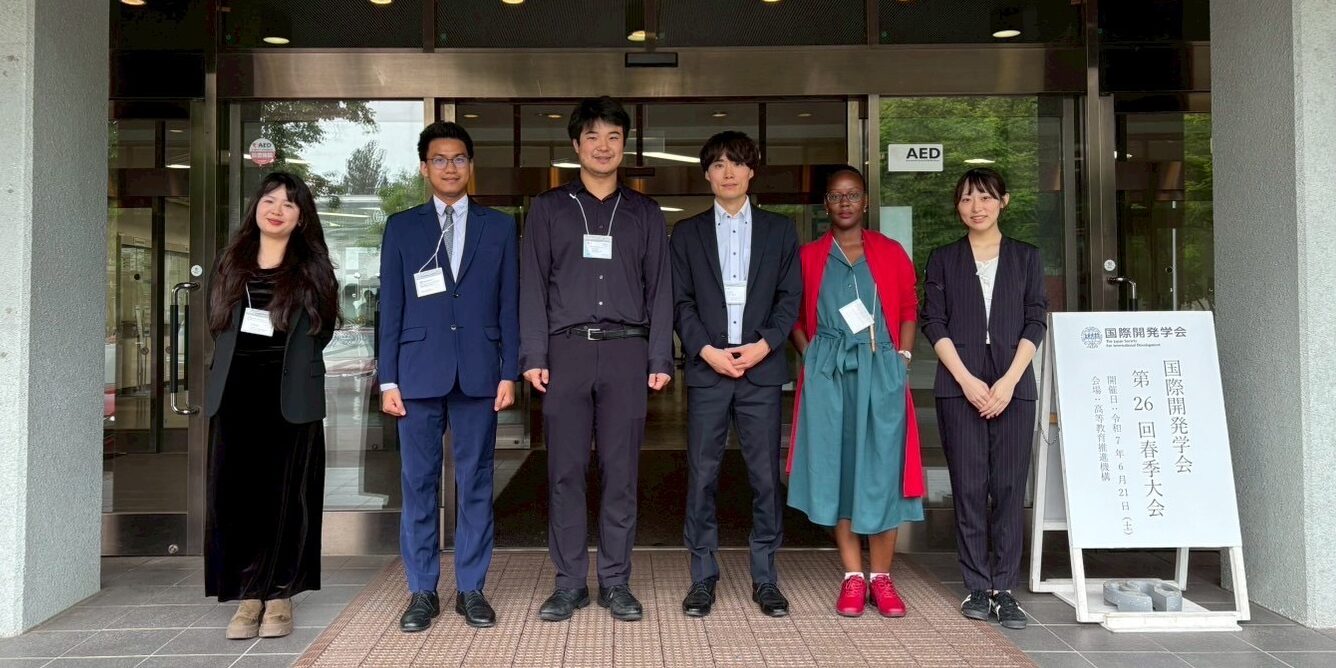
On the 21st of June 2025, the 26th Japan Society for International Development Spring Conference was held at Hokkaido University. A total of 97 research presentations were delivered at the conference, including 67 oral presentations, 9 round tables, 5 planned sessions, 1 book talk, and 15 poster presentations, covering politics, educational development, migration and refugees, sustainability, global development, poverty, gender, peacebuilding, disasters, and sanitary health. From Professor Ogawa’s seminar, 6 doctoral students participated and presented their research findings at the poster session.
Ms. Noa Yokogawa was awarded the “Excellent Poster Prize”, and Mr. Htet Myet Aung was awarded the “Excellent Poster Encouragement Prize.”
 Ms. Noa Yokogawa’s research theme was “The Influence of Horizontal Education-job Mismatch on Wages of Vocational Senior High School Graduates in Indonesia.” Using data from the August 2023 Indonesian Labor Force Survey, her study analyzed the influence of mismatches between fields of study and fields of employment on the wages of vocational senior high school graduates. The results indicated that the wage penalty associated with mismatch was relatively small, ranging from approximately 3% to 6%, compared to findings from other countries. Furthermore, male graduates were more affected by mismatch than female graduates, highlighting the importance of considering gender differences in working conditions when analyzing education-job mismatches.
Mr. Htet Myet Aung’s research theme was “Analysis of Learning-Adjusted Years of Schooling (LAYS) in Six Southeast Asian Countries,” using data from the SEA-PLM 2019 and UNESCO UIS 2025 datasets to analyze LAYS values across different countries. The results revealed significant disparities in LAYS. Vietnam led with 8.50 years, followed by Malaysia with 7.44 years, while Lao PDR ranks the lowest at 0.51 years. The 8.49-year gap highlighted deep inequalities in both access to schooling and learning quality. Vietnam’s high LAYS indicated the success of its effective education policies, whereas Lao PDR’s low value indicated persistent challenges in infrastructure and educational resources. These findings emphasized the urgent need for targeted interventions to close educational gaps in Southeast Asia.
Ogawa seminar students presented their research findings on the following topics. The poster, denoted by (E), is in English. (Alphabetical Order)
- Aung, H. M. “Analysis of Learning-Adjusted Years of Schooling (LAYS) in Six Southeast Asia Countries” Proceedings of the 26th Japan Society for International Development Spring Conference, p43, 2025 (E)
- Bengo, N. A. “Formative Program Evaluation Strategies: A Reflection on the Girls’ Empowerment and Youth Village Projects Implementation in Angola” Proceedings of the 26th Japan Society for International Development Spring Conference, p42, 2025 (E)
- Ishii, Y. “An Analysis of Home-based Involvement on Early Childhood Development in Malawi” Proceedings of the 26th Japan Society for International Development Spring Conference, p42, 2025 (E)
- Uno, K. “Heterogeneous Effects of Pre-primary Education on Early Literacy, Numeracy, Social-emotional, and Physical Development in Bangladesh” Proceedings of the 26th Japan Society for International Development Spring Conference, p43, 2025 (E)
- Yao, J. “An Analysis of the Intercultural Communication Competence of Chinese Overseas Student” Proceedings of the 26th Japan Society for International Development Spring Conference, p42, 2025 (E)
- Yokogawa, N. “The Influence of Horizontal Education-job Mismatch on Wages of Vocational Senior High School Graduates in Indonesia” Proceedings of the 26th Japan Society for International Development Spring Conference, p43, 2025 (E)


Authored by Noa Yokogawa (Doctoral Student)
Related