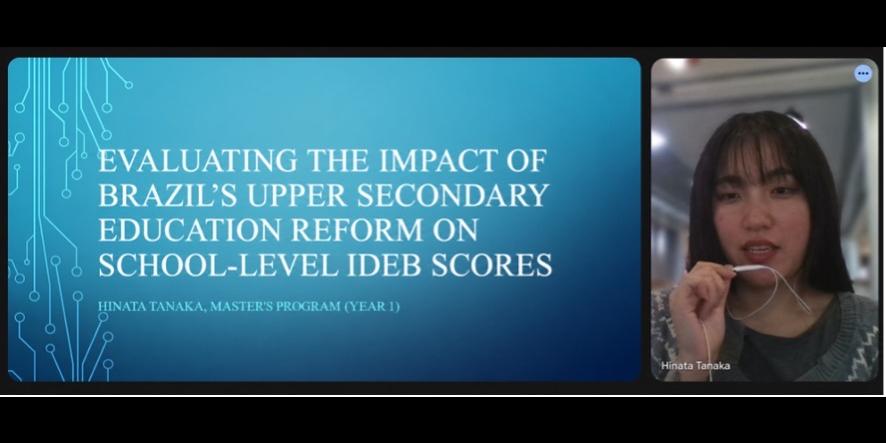
From December 12, 2025 to March 20, 2026, I completed a research internship under the guidance of Dr. Danilo Leite Dalmon. This internship focused on a quantitative analysis of Brazil’s Upper Secondary Education Reform, with particular attention to the expansion of full-time upper secondary education and its relationship with school-level Basic Education Development Index (IDEB) data performance. The primary objective of this internship was to strengthen my skill in quantitative analysis while developing a deeper understanding of the current conditions and structural challenges of Brazil’s education system. To achieve this objective, I had examined whether the adoption of full-time schooling was associated with improvements in school-level educational outcomes.
Under Dr. Danilo’s supervision, I conducted an empirical analysis of state upper secondary schools in Brazil, using school-level IDEB data and administrative information from Censo Escolar, Brazil’s annual national school census. The study focused on the period between 2017 and 2019, which corresponds to the early phase of Brazil’s 2017 Upper Secondary Education Reform. This reform aimed to improve the relevance and efficiency of upper secondary education by diversifying the curriculum, strengthening competency-based learning, and expanding full-time schooling.
The core component of my internship was the construction of an analytical dataset and the implementation of a quantitative research design. I combined IDEB data with Censo Escolar data to identify schools that newly adopted full-time upper secondary education between 2017 and 2019. The final sample was constructed as a balanced panel of state upper secondary schools observed in both years. Through this process, I learned how sample selection, treatment definition, and data cleaning are closely connected to empirical interpretation and the credibility of analysis.
To examine the relationship between full-time schooling and school performance, I applied a difference-in-differences approach using school-level data from 2017 and 2019. This analysis allowed me to compare changes in IDEB scores between schools that newly adopted full-time upper secondary education and those that did not.
The results suggested a modest positive association between the adoption of full-time schooling and improvements in school-level IDEB scores. Through this analysis, I learned that quantitative results should be interpreted carefully in relation to research design, data limitations, and the broader policy context. In particular, I came to understand that statistical significance does not necessarily imply large practical or policy significance.
Overall, this internship was a valuable stage in my academic training, allowing me to connect theoretical knowledge with empirical policy analysis. It strengthened my ability to construct datasets, apply econometric model, interpret regression results, and critically assess the limitations of quantitative research. More importantly, it helped me understand how empirical evidence can contribute to the discussion on education reform, inequality, and learning outcomes.
I would like to express my sincere gratitude to Dr. Danilo for his generous guidance and support throughout this internship. His advice on research design, data analysis, and policy interpretation was invaluable to my academic development. Last but not least, I would like to extend my heartfelt appreciation to Professor Keiichi Ogawa for his continuous mentorship and support, which have greatly contributed to my growth as a master’s student and aspiring educational researcher.
Authored by Hinata Tanaka (Master’s student)
Related